English Assessment Reflection #4
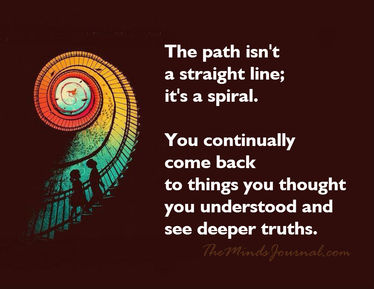
Spirals have been a major theme for me this semester. I've always love the spiral symbol, and how it represents my philosophies- I've even based my business logo on the concept. This semester I chose to focus on the Fibonacci sequence both for my Art creations, my math blog and for a teaching unit. In my research, I was also delighted to learn of the spiral teaching model. This philosophy emphasizes the iterative nature of learning, and states that instead of progressing along a subject in a linear fashion (such as with most textbooks) that teachers can revisit topics over and over again, building in complexity each time. Topics are taught over the course of the whole year, not rammed all into one unit.
"With a spiral curriculum, the belief is that not all students will be able to grasp concepts at the same time on the same level. Therefore as a teacher, you teach a topic and assume that some students are ready to learn and will pick it up and that some are not ready. However you move on and eventually that concept will come up again, for that student to learn. So where a traditional curriculum looks at a few topics for an extended period of time, the spiral curriculum gives you many topics over and over and over." (Clark, pbworks.com)
The spiral teaching philosophy is can also be called progressive inquiry, or iterative learning. No matter it's name, the most important feature of this method is that it allows for differentiation for learners- if a child is not yet ready to learn a concept, they may be ready the next time it is introduced. This allows for the individual's unique stages of development to be respected; they are not penalized for not yet being ready to learn a concept.
This teaching method works well for things like Mathematics, allowing for differentiation, review, and current topic focus. But how does this method apply to Language Arts?
Like Mathematics, Language Arts acquisition concepts can be broken down and simplified. Using a teaching model such as reading and writing workshops allows for teachers to provide mini-lessons, and then for children to do independent study focusing on what they feel they are ready to learn. Self assessment is a huge component of effective workshop formats.
"The focus of a reading curriculum [in the primary years] is usually teaching students the skills they need to independently and successfully read a text. After students are taught to read, they are asked to read to learn new things. This is an example of spiral curriculum in reading: learning to read evolving into reading to learn...The reading curriculum spirals out from simple comprehension skills to more complicated independent reading that requires the use of those skills." (Hughes, Study.com)
What strikes me about both the writers/readers workshop methods and the spiral teaching methodology is the importance of having a long term, consistent and organized plan on how and what you are teaching the students. As a circus teacher, I do not have formalized long term lesson plans for my students- I progress with them at their abilities and according to their interests. While this may also describe a differentiated learning plan, there is an important distinction. Circus, at least at the recreational level, does not have 'core standards' and curricula to which my students are measured.
My reflection has inspired me to begin to develop a rubric for our lessons. While still focused on skill progression, it would provide some recognition and reward other than the intrinsic value of learning and refining skills. Our students should receive some recognition that they have progressed in their practice. I look forward to developing a rubric and reward system (ribbons? Titles? Stickers?) once I have explored Assessment in more detail.
It has been interesting to me to start to see the formalized long term planning that comprises a full time teaching career- and I appreciate the responsibility we will have as teachers to get our learners from Point A to Point B. With long term planning, we can take into account that our students' learning capacities may not march in a straight line. Spiral learning methodology will progress more students along a curving line that will result in more of our students achieving success.
Sources:
http://study.com/academy/lesson/spiral-curriculum-definition-example.html
http://edfn632f10ely.pbworks.com/w/page/28483439/Spiral%20Curriculum
http://www.readersworkshop.org
www.VestaEducation.com
"With a spiral curriculum, the belief is that not all students will be able to grasp concepts at the same time on the same level. Therefore as a teacher, you teach a topic and assume that some students are ready to learn and will pick it up and that some are not ready. However you move on and eventually that concept will come up again, for that student to learn. So where a traditional curriculum looks at a few topics for an extended period of time, the spiral curriculum gives you many topics over and over and over." (Clark, pbworks.com)
The spiral teaching philosophy is can also be called progressive inquiry, or iterative learning. No matter it's name, the most important feature of this method is that it allows for differentiation for learners- if a child is not yet ready to learn a concept, they may be ready the next time it is introduced. This allows for the individual's unique stages of development to be respected; they are not penalized for not yet being ready to learn a concept.
This teaching method works well for things like Mathematics, allowing for differentiation, review, and current topic focus. But how does this method apply to Language Arts?
Like Mathematics, Language Arts acquisition concepts can be broken down and simplified. Using a teaching model such as reading and writing workshops allows for teachers to provide mini-lessons, and then for children to do independent study focusing on what they feel they are ready to learn. Self assessment is a huge component of effective workshop formats.
"The focus of a reading curriculum [in the primary years] is usually teaching students the skills they need to independently and successfully read a text. After students are taught to read, they are asked to read to learn new things. This is an example of spiral curriculum in reading: learning to read evolving into reading to learn...The reading curriculum spirals out from simple comprehension skills to more complicated independent reading that requires the use of those skills." (Hughes, Study.com)
What strikes me about both the writers/readers workshop methods and the spiral teaching methodology is the importance of having a long term, consistent and organized plan on how and what you are teaching the students. As a circus teacher, I do not have formalized long term lesson plans for my students- I progress with them at their abilities and according to their interests. While this may also describe a differentiated learning plan, there is an important distinction. Circus, at least at the recreational level, does not have 'core standards' and curricula to which my students are measured.
My reflection has inspired me to begin to develop a rubric for our lessons. While still focused on skill progression, it would provide some recognition and reward other than the intrinsic value of learning and refining skills. Our students should receive some recognition that they have progressed in their practice. I look forward to developing a rubric and reward system (ribbons? Titles? Stickers?) once I have explored Assessment in more detail.
It has been interesting to me to start to see the formalized long term planning that comprises a full time teaching career- and I appreciate the responsibility we will have as teachers to get our learners from Point A to Point B. With long term planning, we can take into account that our students' learning capacities may not march in a straight line. Spiral learning methodology will progress more students along a curving line that will result in more of our students achieving success.
Sources:
http://study.com/academy/lesson/spiral-curriculum-definition-example.html
http://edfn632f10ely.pbworks.com/w/page/28483439/Spiral%20Curriculum
http://www.readersworkshop.org
www.VestaEducation.com

 RSS Feed
